Helping Irish farmers navigate agricultural policy
Trayce, 2026Summary
Irish farmers face a heavy administrative burden proving compliance with sustainability policy. It requires that they document a significant amount of their farming activities. Trayce is a mobile app that asks farmers to log what happens on their farms in photo, video, voice, or text, then organizes it into a searchable library they can easily retrieve from.
Responsibilities
- Ran field research with Irish farmers: four interviews, two survey rounds reaching around 50 respondents
- Identified record keeping as the core problem from where the surveys and interviews converged
- Reframed the problem from policy compliance to farmer agency supported by peer reviewed literature
- Designed the all core flows around how farmers actually keep records
- Tested design and revised from what the sessions exposed
- Built the Trayce brand identity from naming through logo
Intended outcome
- A 30-second daily capture habit turns compliance from a reactive venture into a standing archive of evidence
- Test whether the daily capture habit survives a busy farming season
- My Role
- Product Design
- Research
- Branding
- Type
- MA Thesis Project
- Tools
- Figma
- NotebookLM
- Perplexity
- Timeline
- 5 months

Context
The Two-Legged Stool
When asked what would make complying with sustainable agricultural policy easier, a survey respondent took the time to write out:
Having some humanity in the system would make complying easier. We have the three legged stool, the financial leg, the environment leg but the social leg is always ignored. And a two legged stool ain't much use.
The Problem
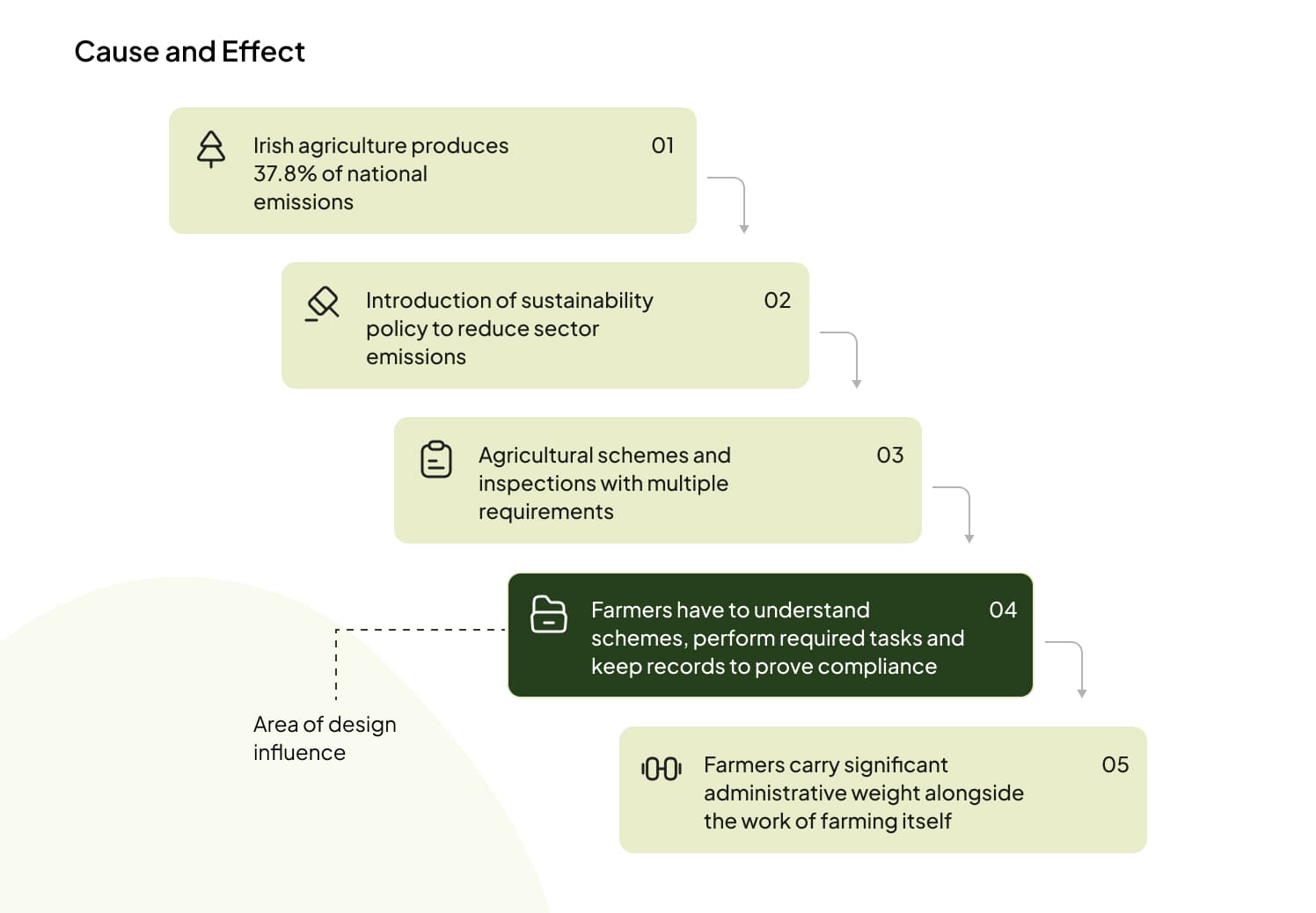
Agriculture accounts for 37.8% of Ireland's emissions, and farmers bear the burden
That figure must be significantly reduced for Ireland to achieve its sustainability goals by 2030. Hence the introduction of a set of Common Agricultural policy aimed at promoting sustainable agricultural practices amongst Irish farmers, but the execution of these policy was quite burdensome on farmers.
Early research helped to map out the sheer breadth of the problem space and identify areas where design could actually have an influence. It was a reasonable place to start. It just wasn't where things ended up.
Field Research
Farmers were harder to find than expected
I used Perplexity to work through existing literature and journals in order to define the problem space, but gaps still remained. I still had no idea how the agricultural policies personally affected the lives of actual farmers and what areas were most problematic, so I took to the farms to find out.
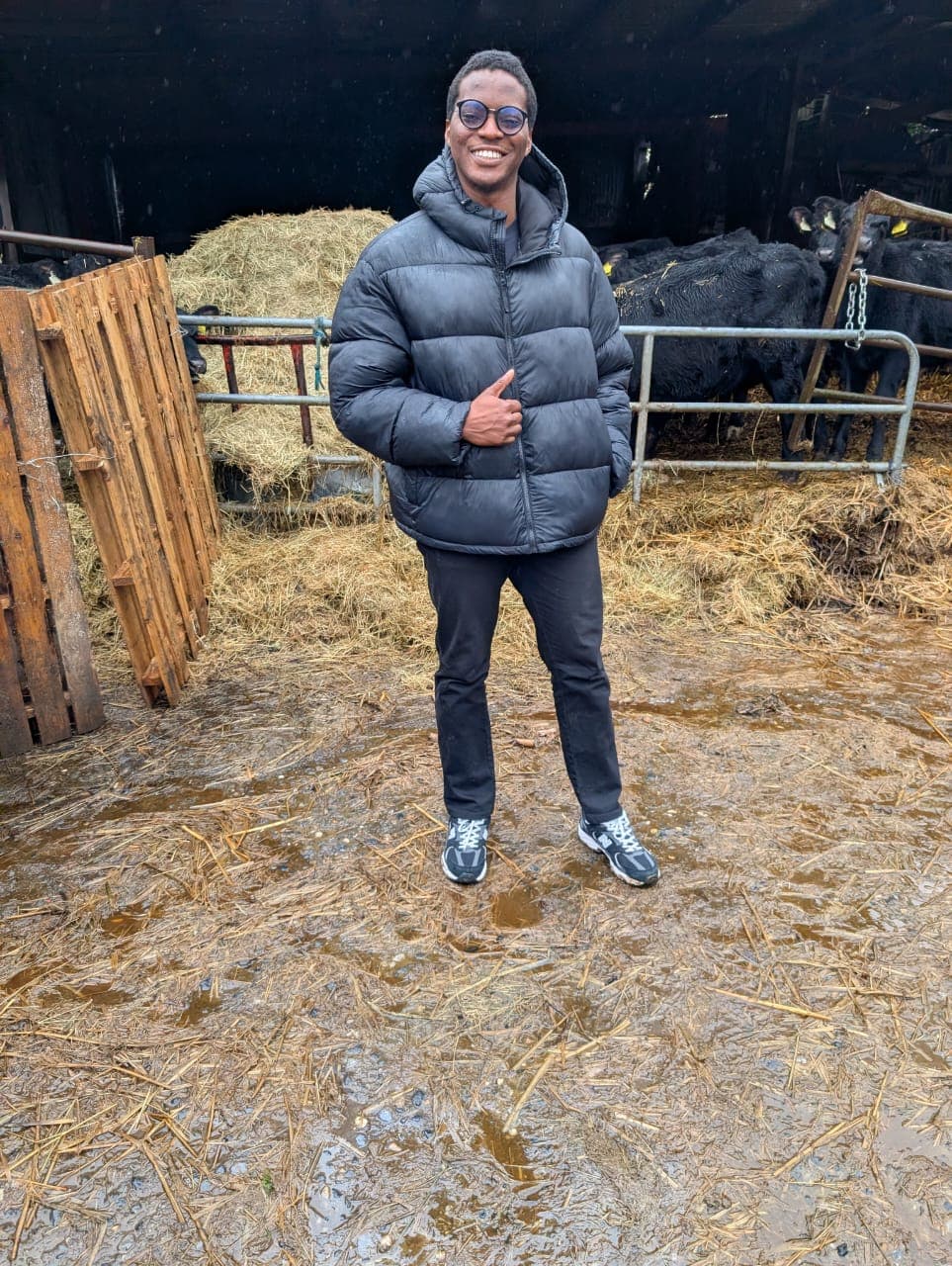
Finding farmers for the study proved more difficult than I had thought. Being an international student with no farming contacts, I had to turn to gatherings such as the local farmers' market and association as well as requesting for farm contacts from lecturers and colleagues. This led to four interviews with 2 of them happening on actual farms (a detail I would come to value later on). Two rounds of surveys also ran alongside, reaching about 50 farmers combined. The second survey was created out of necessity to get more precise responses on areas hinted at by interviews and the first survey.
Synthesis and Findings
Farmers are required to keep an
insane amount of records
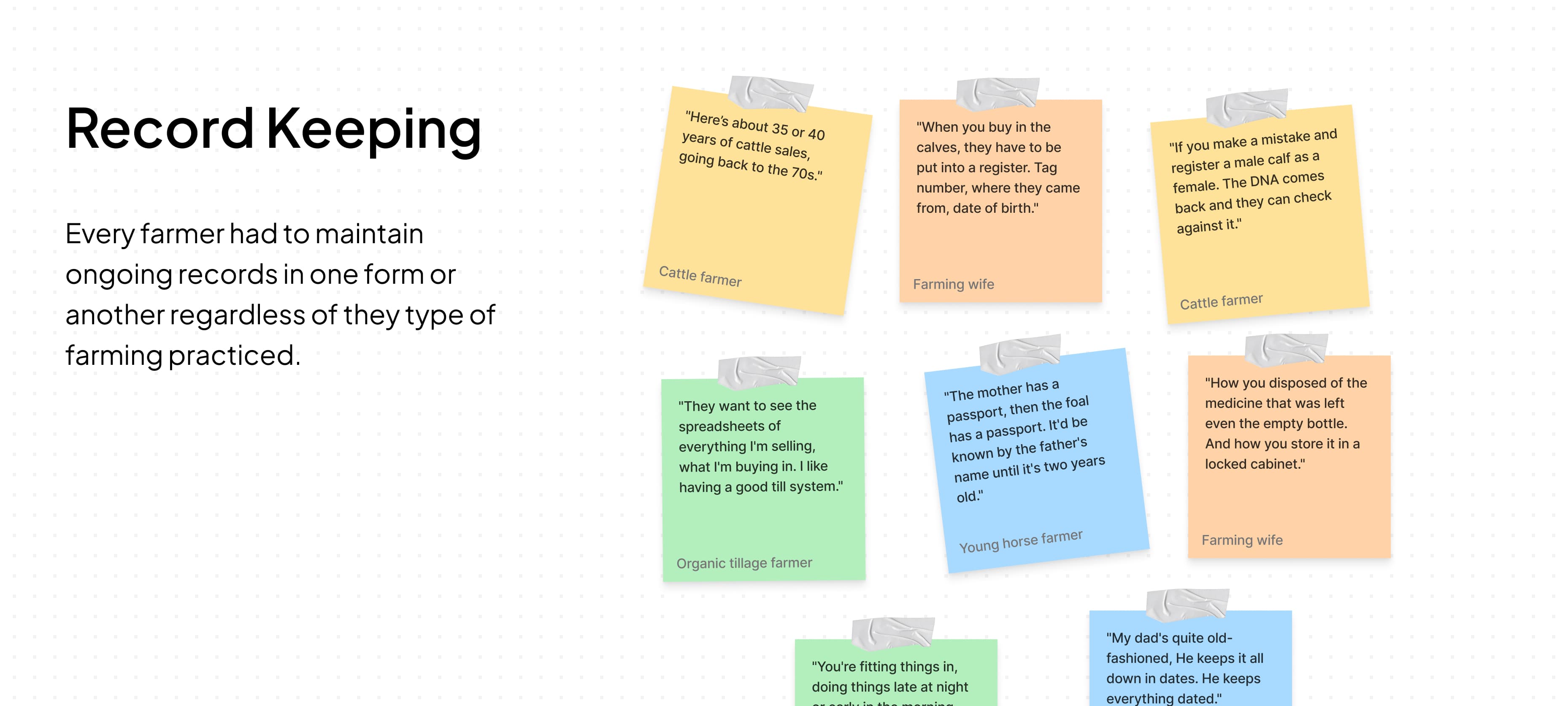
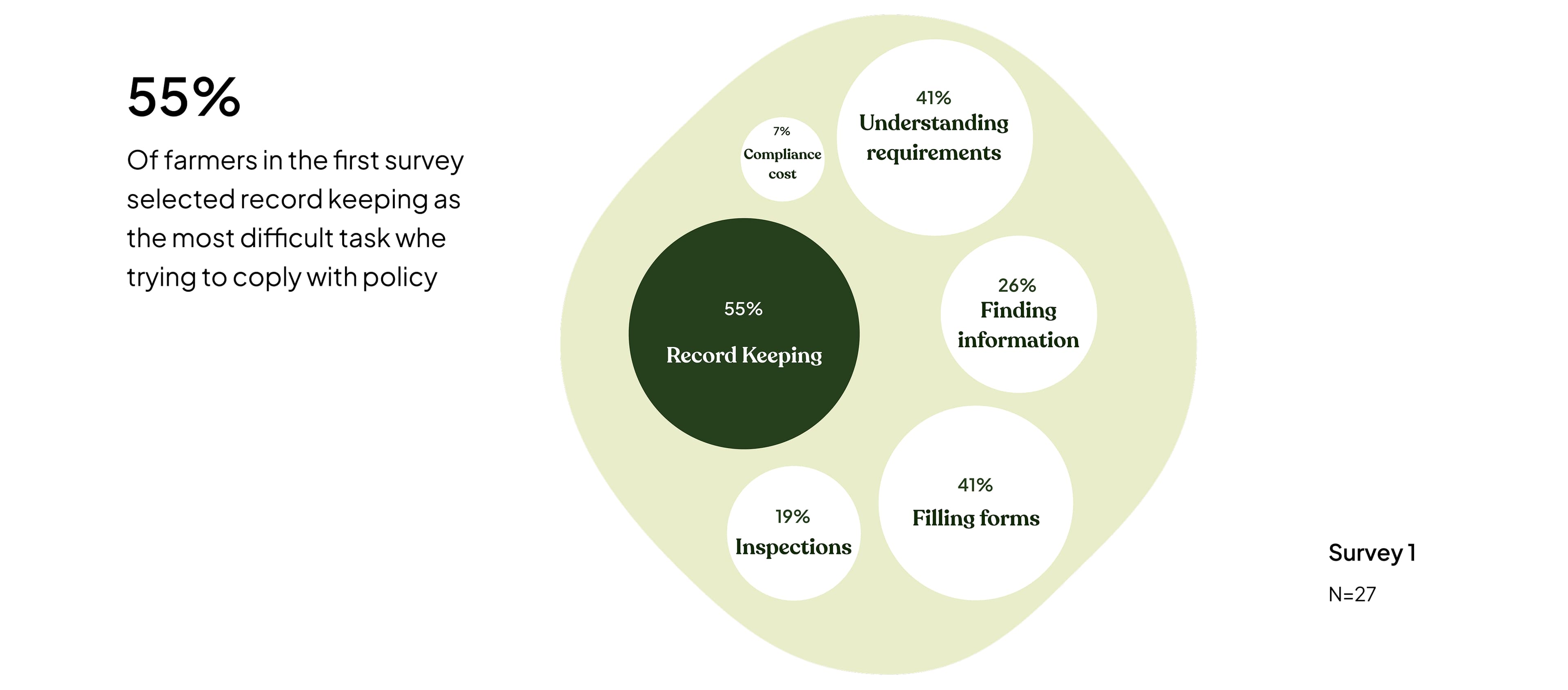
Synthesising the data collected revealed that while the surveys mainly captured frequency, the interviews captured depth. Although, one aspect of compliance stood out across both interviews and surveys: Record Keeping. It was interesting to discover the amount of records an Irish farmer needs to keep as they comply with agricultural policy — everything must be documented, down to the way packaging for drugs administered to animals are disposed of. This provided a possible area to focus on for an effective solution.
Unpredicted Insight
Farming is more than just a profession
I had been so focused on policy compliance that I almost missed a pattern that had been emerging in every interview. Farmers are more than just compliance actors. They spend decades on the same land and about 49 hours a week, bonding with the animals they herd and building something they intended to pass on. This was a concept that showed up in various forms across all the interviews.
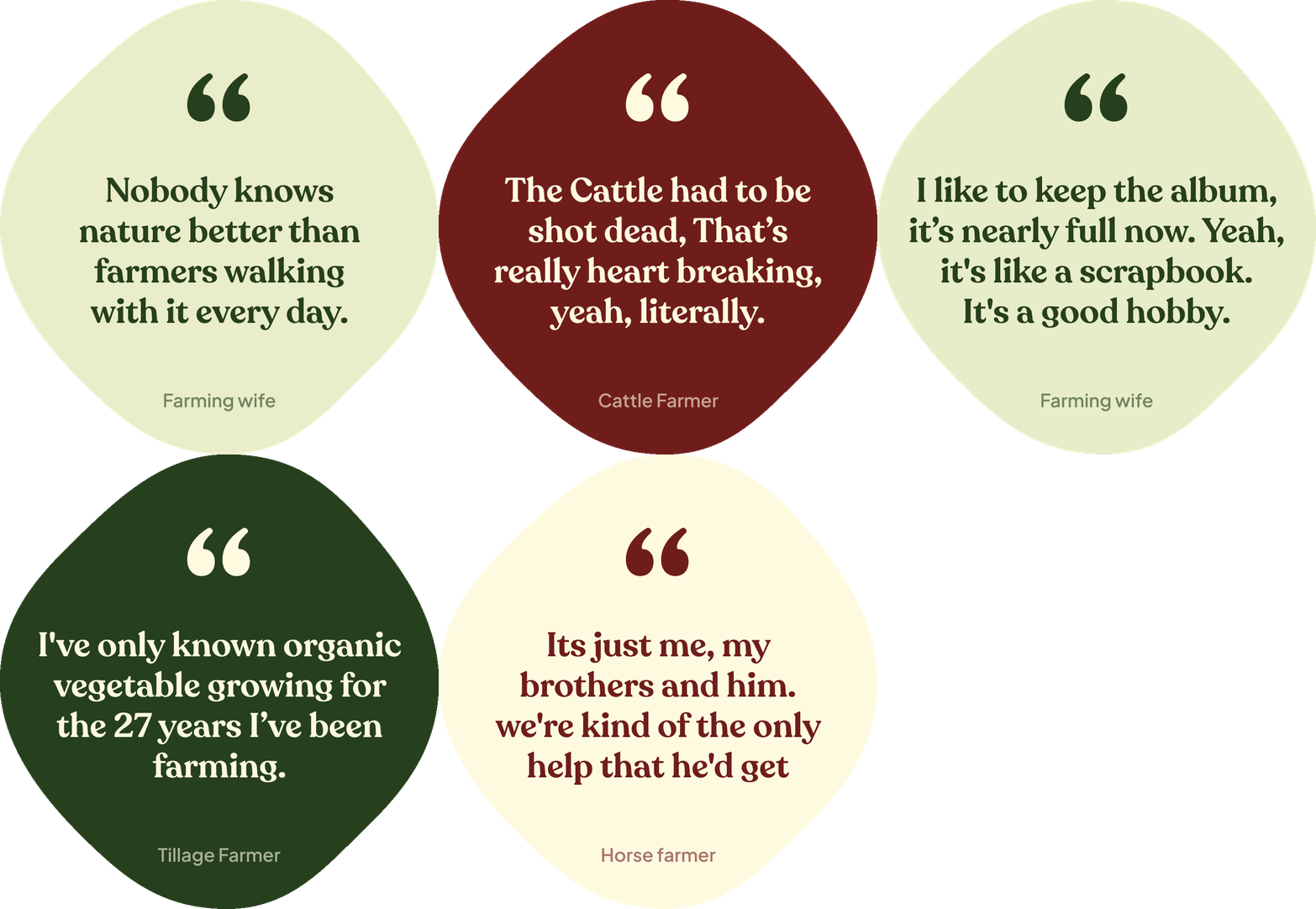
Although I was well aware of the possibility of an emotional bias from spending over 12 hours talking to farmers and hearing how passionate they sounded about their vocation, so I went back to review more literature to see if this aspect of farming was actually captured. I uncovered a series of papers covering land stewardship identity, intergenerational farming, and the emotional weight of the vocation. All of these were not contained in my original framing of the problem and they definitely were not reflected in the current implementations of agricultural policy. The problem statement that came out of this sought to empower the farmer when navigating bureaucracy.
How might we utilise design to help Irish farmers feel equipped and in control as they engage with agricultural policy?
Ideation
The selected direction had to see farmers as more than compliance actors
Up until this point I had not begun considering solutions — the problem space felt too large and the sole focus was on mapping and understanding it. But now having gathered enough authentic data and insights, I began ideating. Three directions came out of the ideation phase, each with roots in the research.
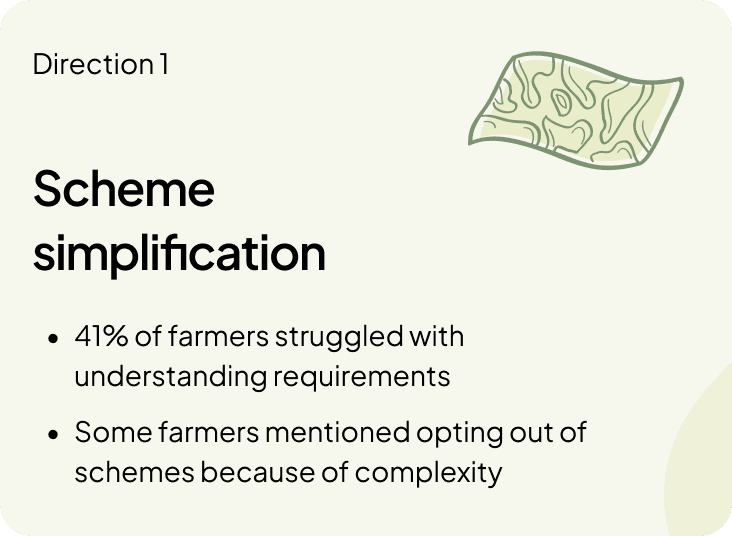
Direction 1: Scheme Simplification
A way to help farmers understand the schemes available to them, navigate eligibility requirements, and apply with less friction. The research had flagged scheme complexity as a major barrier.
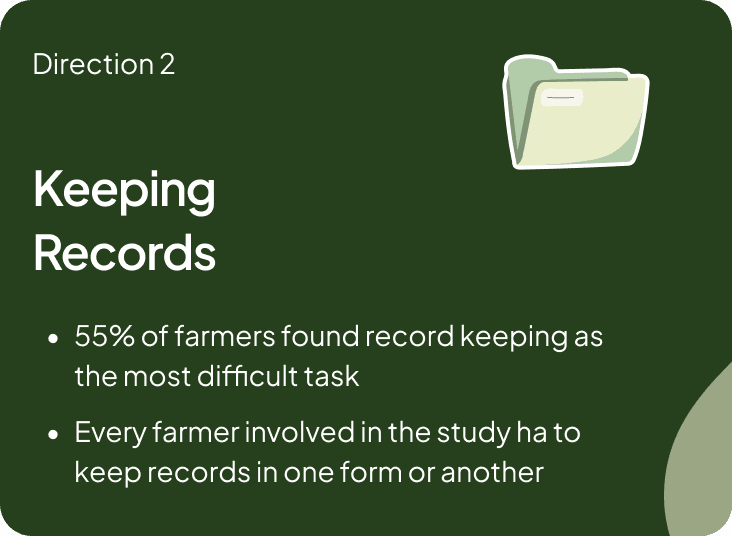
Idea 2: Recording Memories
Daily farm activity capture tool. Log farm events, organise them and retrieve it when needed. Building compliance evidence and personal records from the same habit. Record keeping proved to be the most difficult aspect of compliance.
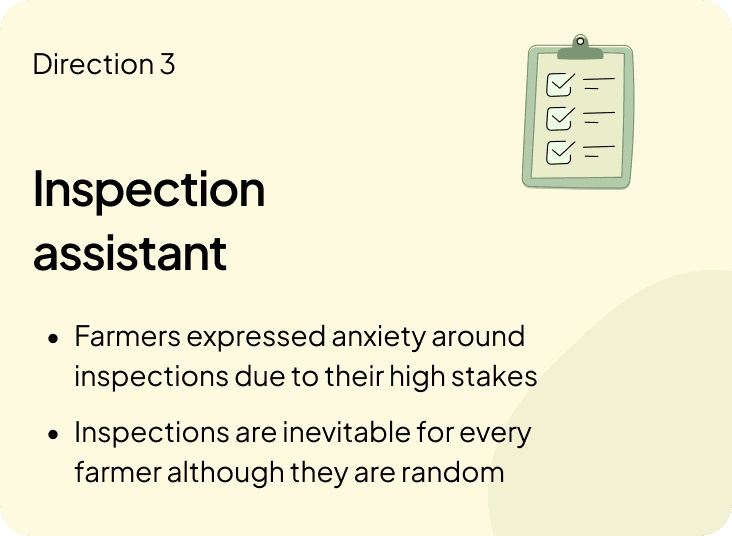
Idea 3: Inspection assistant
A tool to help farmers prepare for and feel more in control during inspections. Anxiety around inspections was a real pain point for farmers due to its randomness and dependence on the nature of the inspector.
Idea 2 was the one the research kept pointing at. Record keeping emerged as the single most consistent finding across both surveys and all four interviews. It was also the only direction that addressed the farmer as a whole person rather than as a compliance actor and did not rely on external input to be valid amongst the three.
Core Design Flows
Capturing, Organizing and Retrieving
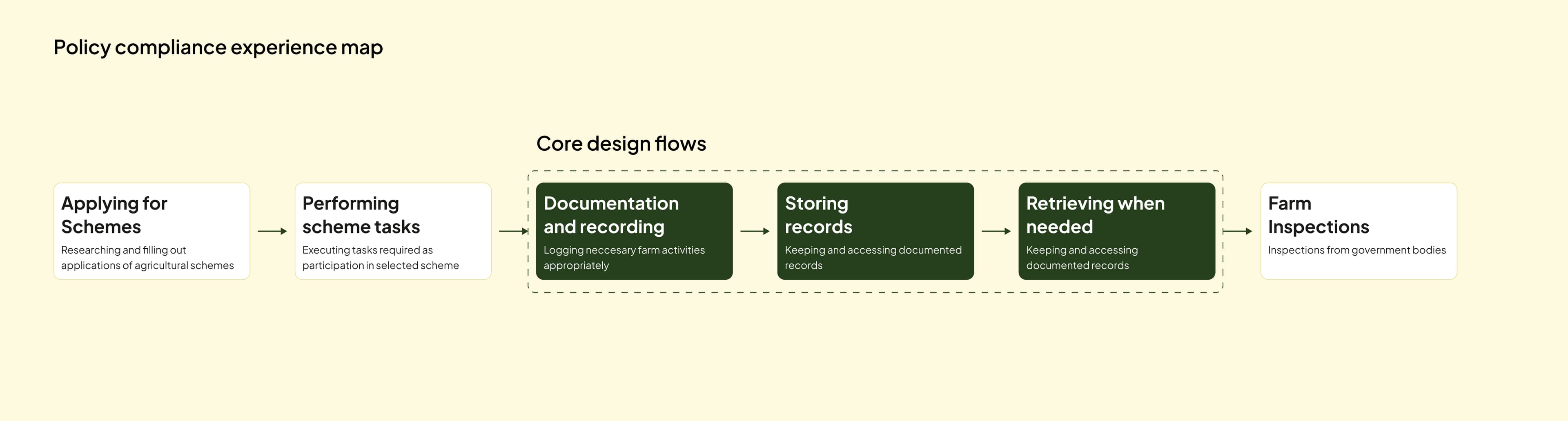
The design needed to be simple. Research from official EU sources had flagged that farmers were struggling with the current complexity of the digital systems they interact with when complying with agricultural policy. Based off of the farmer experience map when keeping records, the core functionalities were summarised into 3 major flows.
User Testing
Where it Broke
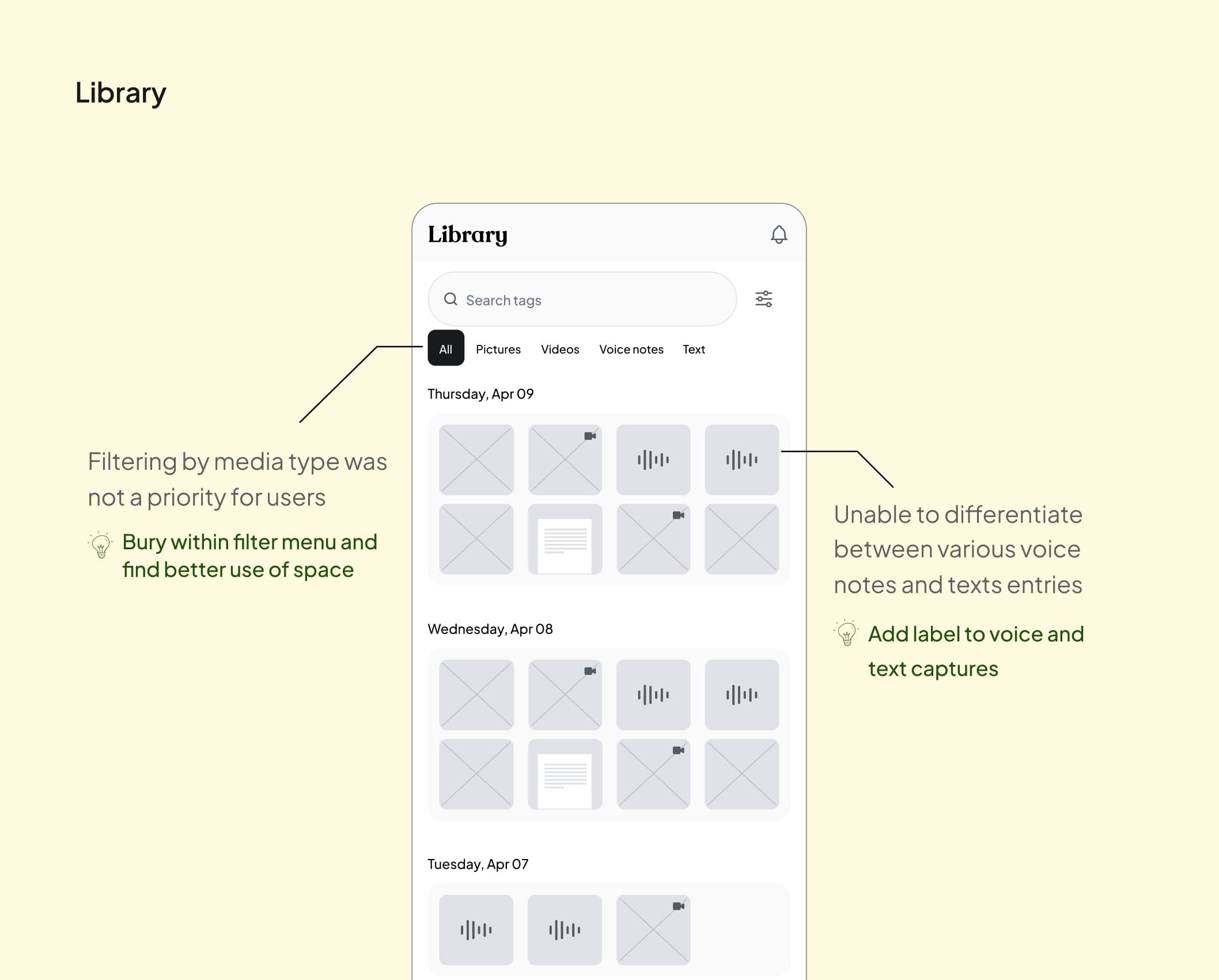
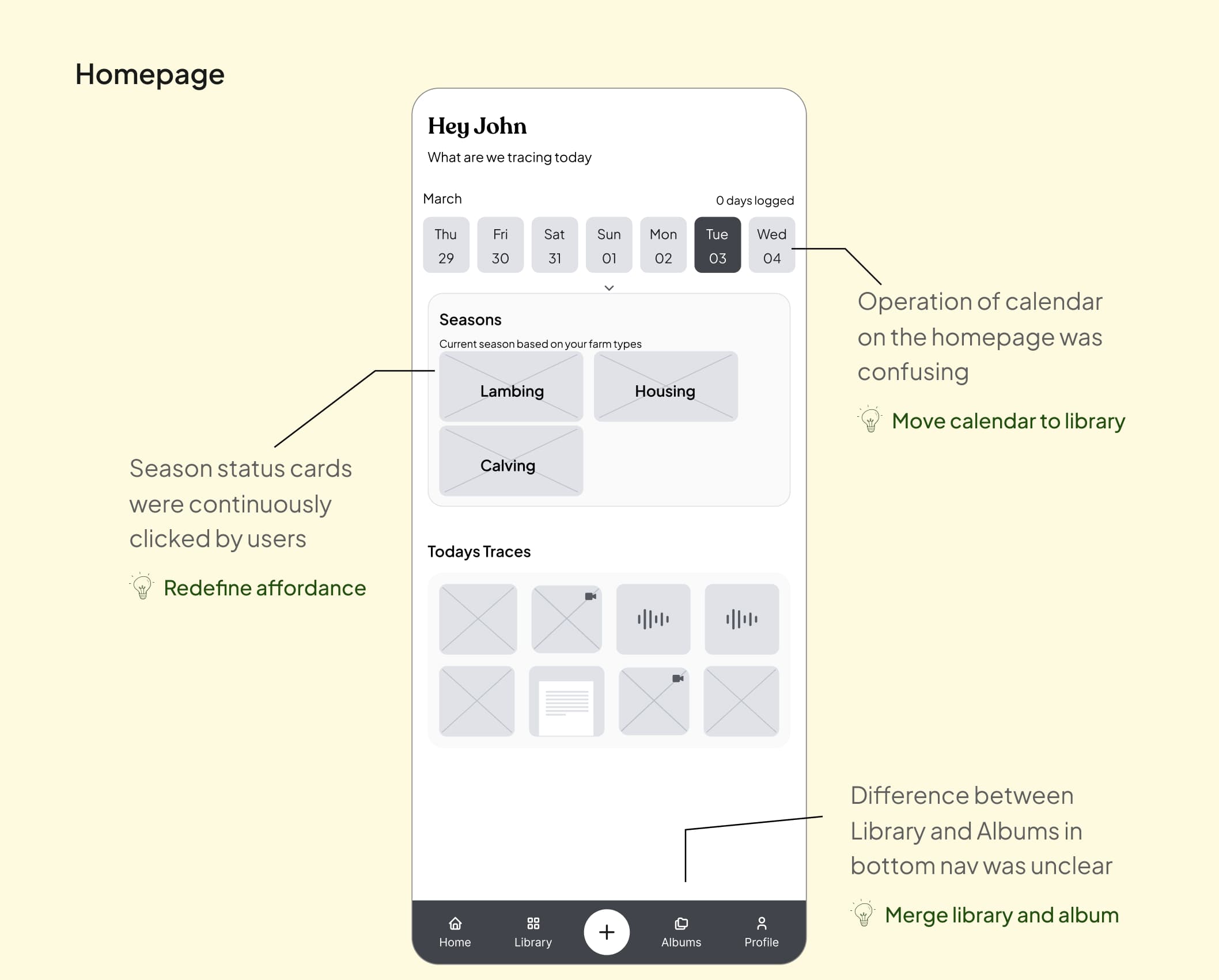
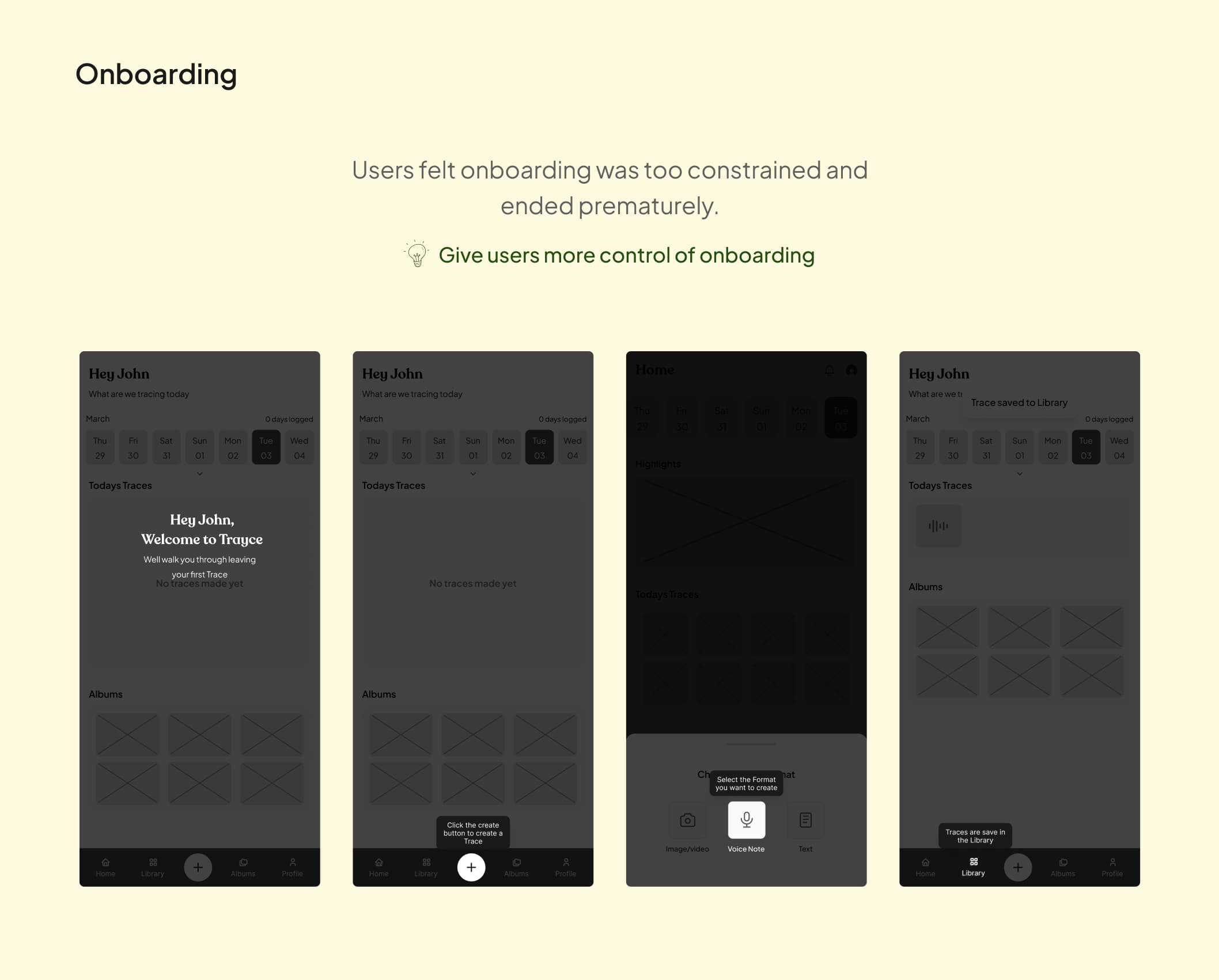
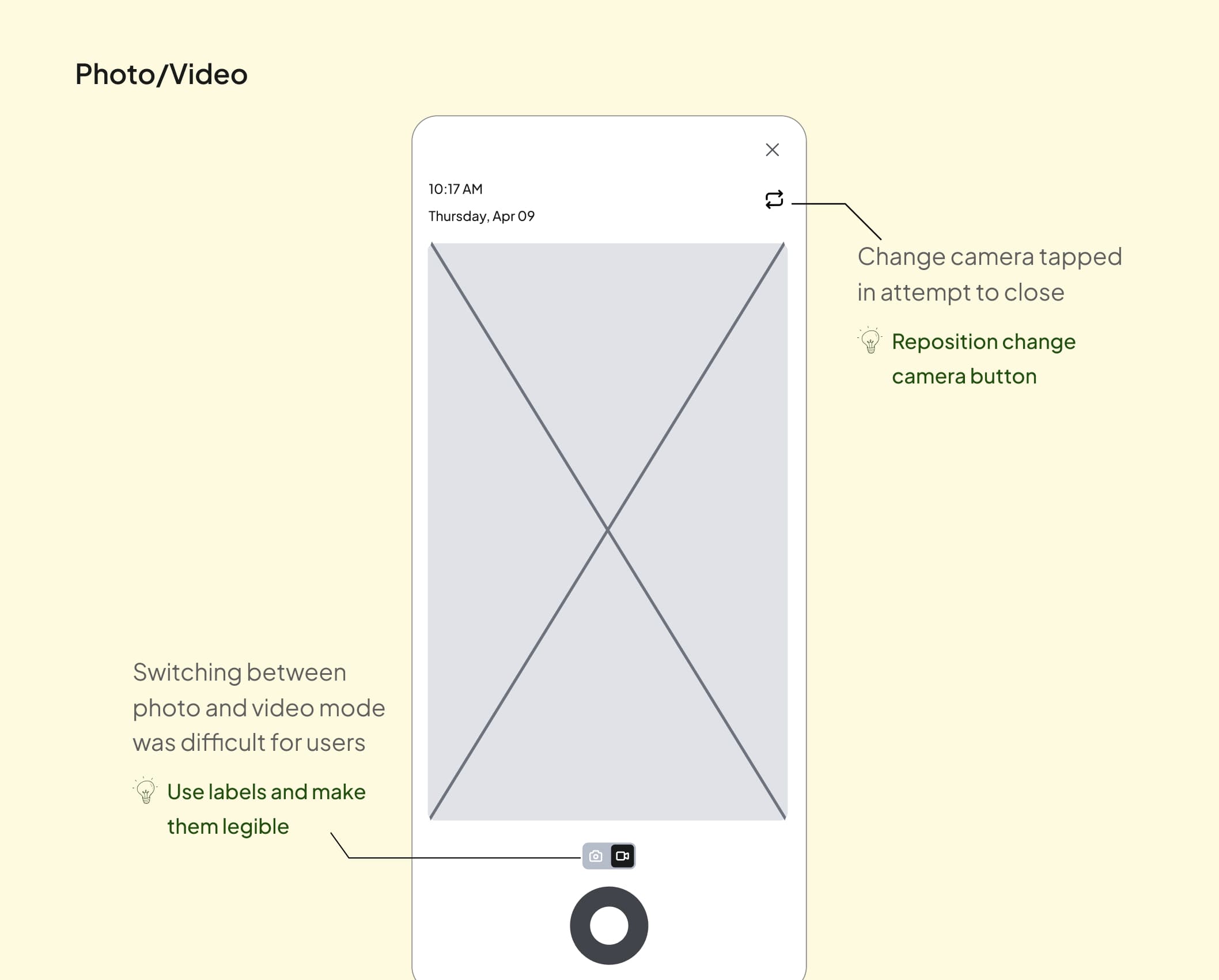
I then had my flows designed up to mid fidelity, but I needed to get it into the hands of users so that any gaps present might be revealed before bumping up the fidelity. I got 3 users to test: a part-time farm worker, a designer (for usability flows), and a farmer. The testing revealed the following gaps and inspired direct modifications to address these concerns.
Branding
Identity Rooted in the Land
The naming came from the concept of leaving a trace and the logo was inspired by the rings of a tree which can be used to tell the age of the tree and what sort of life the tree lived, but in this case it'd be doing the same for farmers.

The Solution
Leaving a Trace
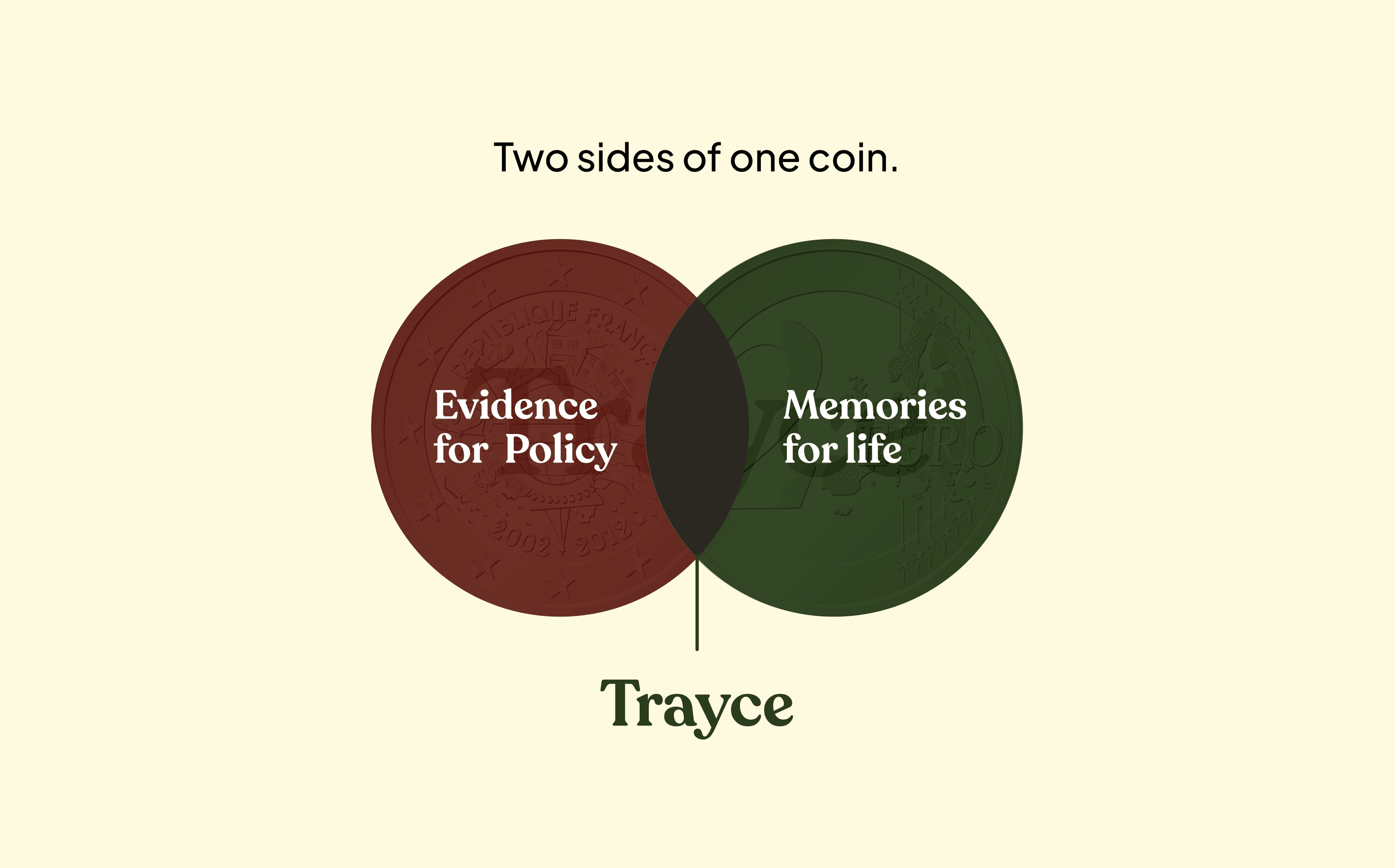
Trayce asks one thing of a farmer: log what happened today. A photo of a new calf. A voice note about a treatment administered. A quick text about a delivery. Over time, those daily captures build into something useful. A well of evidence that equips the farmer to be confident when navigating bureaucracy while being an archive of personal memories of farm life.
Some of the major flows of Trayce include:
Capturing
Farmers can quickly log events in multiple media formats
Organizing
Captured records stack chronologically and can be curated into Albums depending on farmer preference
Retrieving
Easily retrieve captured records either by searching or navigating to a particular day.
Final Thoughts
Looking back, Looking forward
Separate area of concern from area of influence
The deeper the research went, the clearer it became that many of the most pressing issues farmers face sit with government structures and policy frameworks that interaction design can't touch. Mapping out the areas where design could actually influence a solution was key at the early stages of research.
Designing for people thrown into unfamiliar user experiences
The problem that kept surfacing throughout this research goes beyond farming. In a bid to comply with sustainability policies, individuals across many sectors are being asked to navigate systems that feel designed without them in mind. The burden falls on the people least equipped to carry it. Agriculture was the context for this research but the pattern is much wider than that, and one I plan to keep designing around.
Next step: Validating habit formation
The hypothesis suggests that a daily capture habit, built up over weeks and months, generates a backlog of evidence that makes compliance less reactive. The design creates the conditions for that habit to form, but the sustainability of these habits is subject to time and iterations.